The family atlas
A line you can question, not just admire.
Every connection has an evidence type and an assessment. Select a person to see what supports the line—and where certainty changes.
Reading the family records
How do Benjamin, George, James S., and James L. connect?
James S. · named son
Benjamin’s 1853 will calls James S. Meason his son. A separate 1855 deed names James S. as a grantee.[65][28]
George · indirect son
George’s placement as Benjamin’s son is a high-confidence conclusion from indirect evidence. No reviewed record states their relationship outright. Follow the evidence[28][33][59][60][61][62]
James L. · Missouri
A Missouri James L. shares a different 1855 deed with George and John Kippers, then appears in an 1860–1880 census sequence. Those records do not say how James L. was related to Benjamin, George, or James S.[28][62][63][64]
Elder James L. · Texas
In Texas, an elder James L. is called James R.’s uncle in 1900. A likely matching 1919 death record names Benjamin as his father. Whether he was the Missouri James L. remains unresolved: Missouri censuses say Kentucky-born, while the Texas records say Missouri-born.[59][60][62][63][64]
Benjamin’s 1850 household also lists a James Mason without a middle initial or relationship. That entry cannot yet be assigned to James S. or James L.[1]
The direct line
Select a person to follow the evidence.
The dashed connection is an accepted high-confidence conclusion from indirect evidence—not a direct parentage statement.
Swipe or use the arrow keys to see every generation →
Selected person
Benjamin Meason
Born about 1776 · died 1853 · Kentucky → Missouri
Benjamin’s Kentucky and Missouri records document his household, land, and will. His own parents remain unknown.[1][2][11][13][28][33][36][59][60][61][62][63][64][65][66]
- Relationship to narrator
- Fourth great-grandfather · working conclusion
- Lineage assessment
- high confidence · indirect evidence
Lineage connection
Benjamin Meason → George M. Meason
George’s placement as Benjamin’s son is accepted because multiple independent records converge around the same family network.[1][28][33][59][60][61][62][63][64]
Boundary: No reviewed record states in one sentence that George was Benjamin’s son. The Texas elder James L. was reported as Missouri-born, while the Missouri James L. was repeatedly reported as Kentucky-born; no 1880–1900 record bridges them. Neither man is identified with Benjamin’s separately documented son James S.
Read the George connection case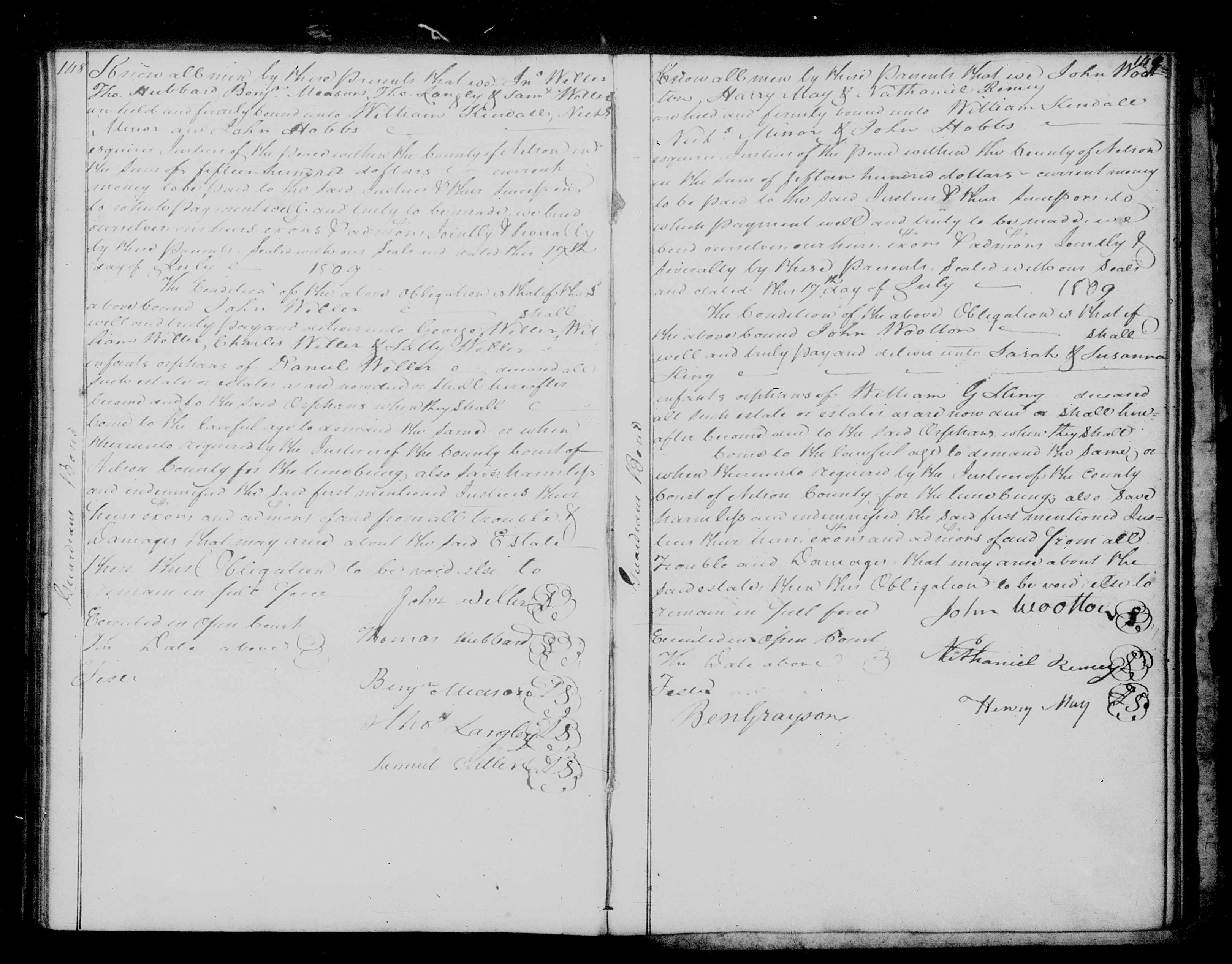
Original record · 1802
Benjamin signed this Nelson County guardian bond “Benjn Meason.” It documents his presence and handwriting—not his parents.[5]
Nelson County court record; public-site research copy
The geographic thread
Kentucky → Missouri → Texas
The records document the family at these stops. They do not preserve every departure, route, reason, or traveling party between them.
- 011800–1820
Kentucky
Tax returns, a marriage bond, and a census place Benjamin and his household first in Nelson County and later in Shelby County.[2][4][10]
- 021829–1880
Missouri
Patents, households, land transactions, and working lives carry the documented family network through Ralls and Monroe Counties.[11][13][28][64]
- 031880 onward
Texas
George appears in Missouri in 1870 and in Dallas County in 1880. Later Dallas records carry the direct line forward, while the route, date, and reason for the move remain unrecorded.[33][56][57][58][74][75][76]
Evidence neighborhoods
See what clusters around the documented line.
These are typed research connections—not extra branches on the family tree. A household, deed, occupation, or repeated neighbor can add context without becoming proof of kinship.
1829–1880
A Missouri network between the lines
Households, a shared land transaction, named family, and working lives repeatedly place the same people around Benjamin’s family.
Select a node to trace only its documented and contextual connections.
Boundary: The cluster is evidence of a durable social and family network. Proximity, occupation, and shared land do not independently prove parentage.